
Growing Pains, Growing Business
When it’s just you, business development barely feels like a separate job. You know the people in your network. The person who gets hired is the person who does the work. Each project becomes its own pitch, because the client experiences you directly and tells others about it. For many people who start a consulting or mission-driven practice, that is how the first several years go, and it works.
Then the firm starts to grow. You bring on a project lead, then a couple of consultants, maybe someone to run operations. There is more capacity and more work to fill it. And at some point, usually without a clear moment, sales stops being easy. The founder is pulled deep into delivery, the conversations that used to bring in the next project stop happening, and a few months later the pipeline is thinner than anyone expected. The relationships that built the firm are still there, but they all run through one or two people who no longer have time to tend them.
This is the stage I want to talk about: a firm that is past being one person but still small, without a business development team and not looking to build one.
Why this stage is harder right now
A few things make this moment more demanding for growing service firms than it was even a few years ago.
Clients are under strain. Many of the organizations these firms serve are absorbing funding losses while demand for their work rises. In a recent Center for Effective Philanthropy survey, 68 percent of nonprofits reported losing funding from at least one source, and about two-thirds reported increased demand for their services. Organizations in that position are careful about who they bring in. They tend to return to people they already trust, or to people someone they trust recommends.
AI has made outreach cheap, but not trust. Proposals, emails and content are easier to produce than ever, so every inbox is fuller. Buyers are using AI to research, but they are checking what it tells them. In TrustRadius’s 2026 report on business technology buyers, 63 percent used AI during a purchase and 94 percent of those fact-checked it, with prior experience and peer input still among the most influential factors. For a service firm, that means the evidence of your work, and what clients say about it, carries more weight, not less.
Growth takes more deliberate effort. Hinge’s 2026 study of consulting firms put median growth at a ten-year low. The fastest-growing firms in the study relied less on referrals alone and were more likely to have their subject-matter experts actively visible, not just the founder.
Taken together, the relationships and reputation that carried a firm through its early years still matter most. They just can’t all sit with one person anymore.
Business development is more than one job
The usual answer to a thinning pipeline is to hire someone to sell. For a firm of five or fifteen people, that is often the wrong move. It is expensive, it takes time to pay off, and in a relationship-led firm, clients want to talk to the people who will do the work.
The alternative is to share business development across the people you already have. That starts with recognizing that business development is not one activity. In the framework I use with firms, Shared Business Development, it is six:
Be seen. Make it easy for the right people to know who the firm is, what it does and when to think of it.
Stay close. Keep up relationships with people who could need, fund, refer or partner on the work, without an immediate ask.
Spot. Notice a possible need and bring it into the firm so someone can act on it.
Shape. Work with the client to understand the need, test fit and define the right approach, including whether the firm is the right one.
Secure. Turn a shaped opportunity into an agreed scope, price and contract.
Steward. Deliver strong work, deepen the relationship and turn results into repeat work, referrals and reputation.
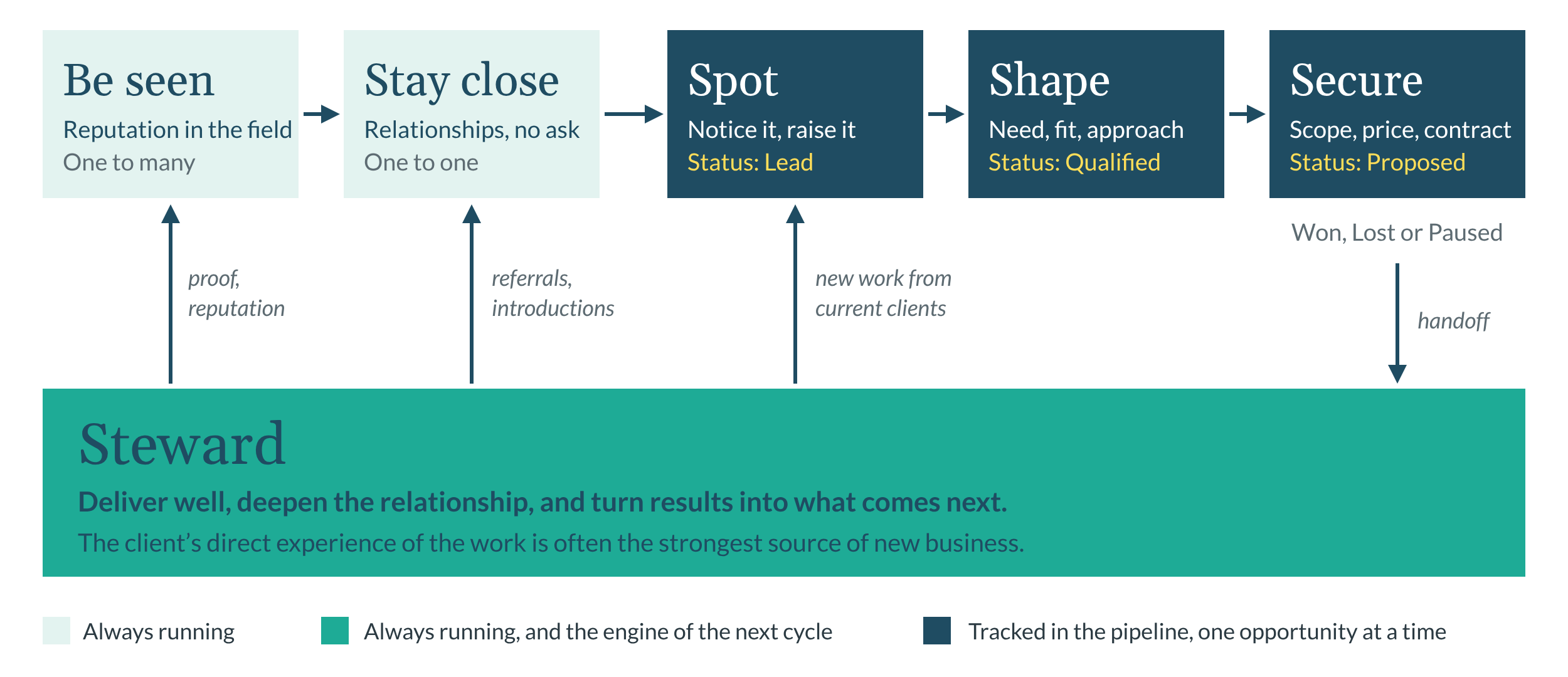
When it’s just you, you do all six without thinking about it. As the firm grows, naming them makes it possible to hand some of them off, see which ones are being neglected, and stop expecting the founder to carry all of them.
What sharing it looks like in a small firm
The founder keeps what only the founder can do. That usually means Shape and Secure and the most important relationships. The founder no longer has to be the only one who is visible or the only one who notices an opportunity.
Project leads own Steward. They are closest to current clients, so they are expected to deliver strong work, notice emerging needs and raise them, and flag a strained relationship early. They are not asked to sell. Scoping, pricing and asking for new work stay with whoever leads Shape and Secure.
Anyone can Spot. A consultant who hears a client mention a new challenge has a simple way to raise it, and gets credit for it.
Every relationship has an owner. Several people may know a client or funder, but one person is responsible for keeping that relationship active.
Saying no is part of the process. Because Shape includes testing fit, declining or pausing work that is not right for the firm is a legitimate outcome, not a lost sale.
In a firm of six people, one person may hold three of these parts. That is fine. The point is that every part has someone.
Your next work is probably in your current work
Underneath all of this is a simple premise: current client work is a growing firm’s strongest business development tool. When clients are cautious and trust carries more weight, how a firm delivers and stays in touch after a contract is signed deserves as much attention as what it takes to win the work.
One practical way to see this in your own firm is to record where each new opportunity comes from: a repeat client, a client referral, another referral or partner, an existing relationship, or visibility. Over a year, that shows how much new work comes from the clients you already have, and where your time is best spent.
Download the framework and toolkit
I have put the full framework into a free guide for leaders of growing service firms. It includes the six parts, an illustrative role table for firms of 5 to 30 people, a monthly and quarterly management rhythm, and a set of tools for putting it into practice:
A self-assessment to see where business development sits today
A role assignment worksheet
A priority relationships list
A Spot intake form and questions for testing fit
A handoff to delivery brief and a client check-in guide
An engagement close-out checklist and an annual source review
A monthly pipeline review agenda and a 90-day getting-started plan
If you are in this stage and want to talk through how it could work in your firm, I would be glad to hear from you.